

How did this project come about?
We are friends with the owner and his family and had already worked together on a number of other projects. He is a collector with a keen interest in interior design. In this house, we designed both the kitchen and the bathroom.
How would you describe the kitchen?
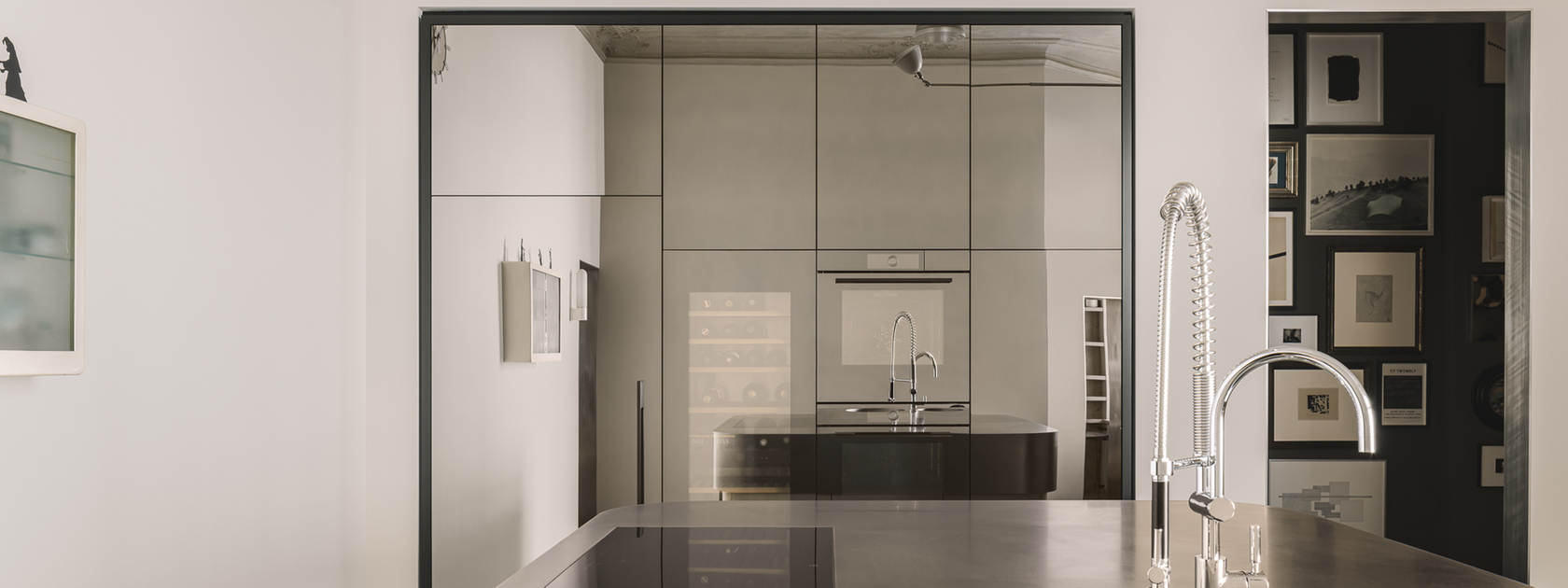
I would start with the room itself. It’s a historic space with stucco ceilings, mirrored by the aluminum floor, an ultra-modern element we created, inspired by a Schinkel Church in Petzow, close to Potsdam. The counter reflects the design language of the 1960s, while the V-ZUG appliances integrate eclectically into the room. The owner added many antiques and historical elements, such as the industrial Johan Petter Johansson Triplex Telescopic wall lamps paired with a Zeiss ceiling lamp. In a few words, the kitchen is minimalist, iconic, and peculiar.
Can you tell us more about the counter?
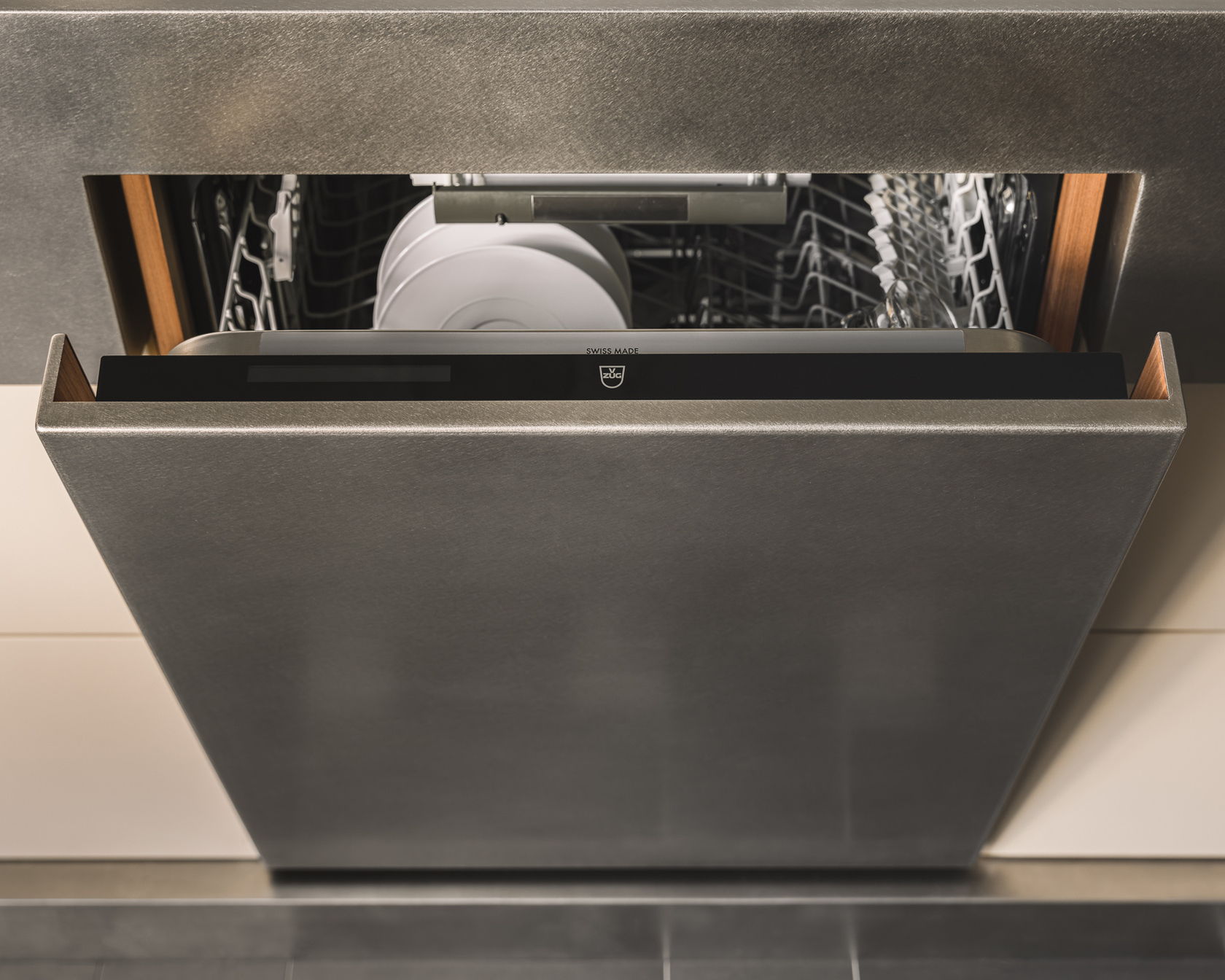
It is very expressive. It was inspired by a 1960s model by Alpes-Inox, an Italian company. We’re very good at designing kitchen blocks of any shape. This is the first square one, but we didn’t want it to feel too angular in the room, so we opted for rounded corners. Then we found a metalworker through the Michelin-starred restaurant ETZ in Nuremberg – Stefan Vogel, who took over his father’s forge – and we built the block with him. As for the color: the owner had an old butcher's block from the 1950s in a typical eggshell shade. We decided to pick up that tone, and choose stainless steel for the top.
How did the idea of the glass kitchen cabinet come about?
The room itself is rather small and receives little natural light, entering only through a slanted window. And the owner wanted many appliances – the oven, the fridge, the wine cooler. Conceptually, he wanted to incorporate everything the V-ZUG range offered. We decided to recess the cabinets into the wall, so that no volume protrudes into the room, and opted for a seamless glass surface – using the same glass as the V-ZUG oven and wine cooler doors. This immediately makes the room feel larger. That’s why we love working with glass and the resulting mirror effect.
Why did you choose V-ZUG for the kitchen?
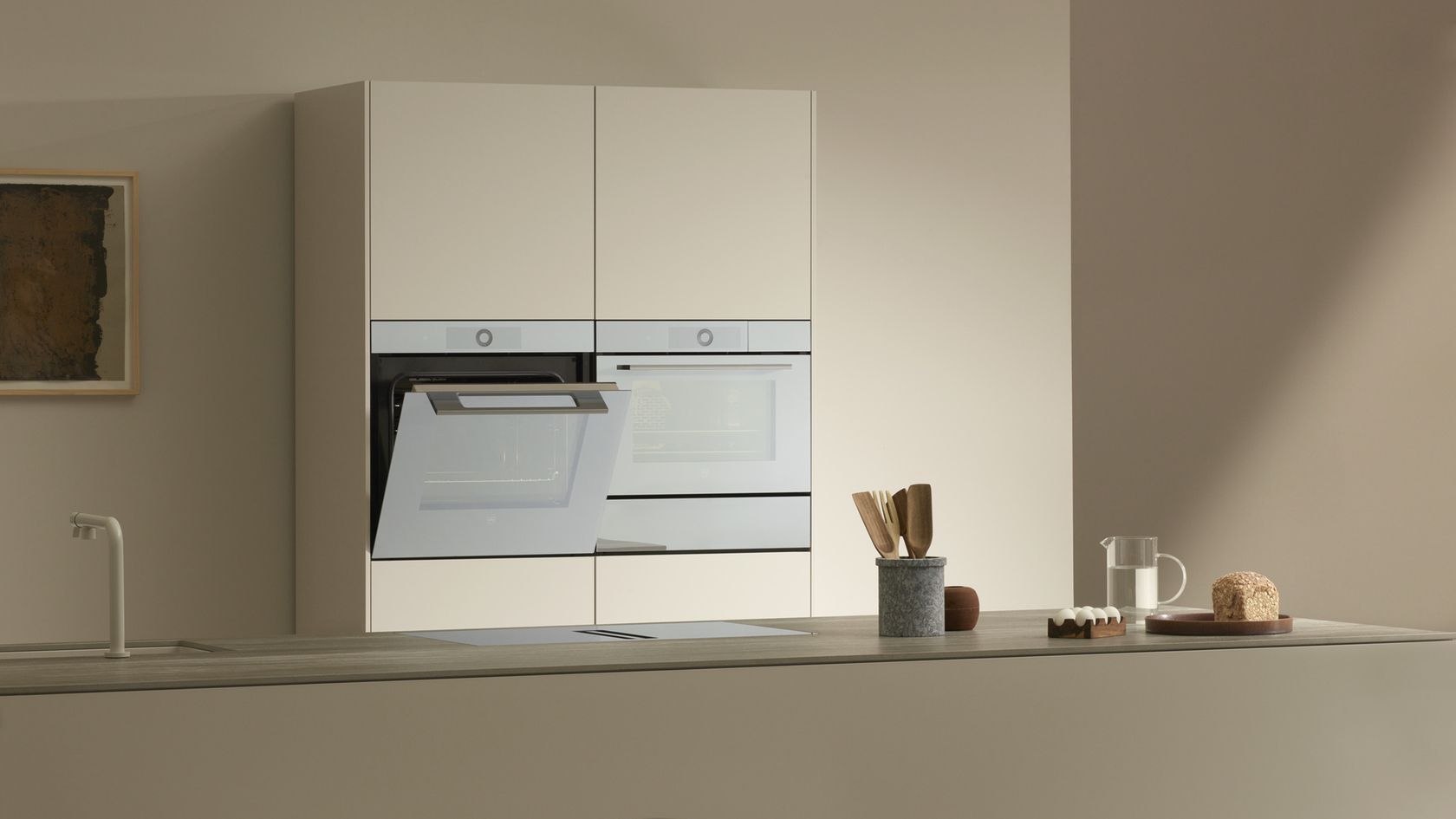
Because it was thanks to V-ZUG that the idea of a “glass kitchen” first took shape. In the past we mostly worked on office projects, where kitchens were small and often lacked charm. Then, at a trade fair in Cologne some years ago, we discovered the fascinating and highly minimalist V-ZUG appliances. When we later designed our office, we created a glass kitchen integrating their appliances, which unexpectedly became a success. In essence, we simply applied the design element of glass – the same that gives V-ZUG appliances their minimalist character – to the entire room. Here too, of course, the owner likes the brand, but from an interior design perspective the real appeal lies in reflection. The mirror effect visually expands the small kitchen, it’s such a beautiful architectural detail. The V-ZUG mirrored glass widens the room and brings in light, but not intrusively, as the black glass subtly dims it. V-ZUG simply has brilliant product design. They took the square box, because that’s what an oven or steam oven is, and reduced it to the essentials.
You seem to have a passion for kitchens.
Yes. We both like to eat, cook and bake, and this is why we love designing kitchens. Susanne and I always say: the measure of all things is the custom-built kitchen. When we build a carpenter-made kitchen and combine it with V-ZUG, it’s about delivering exceptional performance paired with understatement. And I think we now have an audience that appreciates that. Kitchens are the heart of a home; they touch people’s hearts.